Census ACS 5-Year · 52 states
Most Educated States
Educational attainment is one of the strongest predictors of economic outcomes, and state-level differences are striking. Massachusetts leads the nation with over 45% of adults holding a bachelor's degree or higher, driven by its concentration of world-class universities and the knowledge-economy jobs they support. Colorado, Connecticut, and Maryland follow closely, all benefiting from strong demand for educated workers in government, technology, and professional services. The correlation between education and income is unmistakable: the most educated states almost perfectly overlap with the highest-income states. However, educational attainment is also strongly influenced by migration, states with vibrant economies attract college-educated workers from across the country, while states with weaker economies experience "brain drain" as graduates leave for better opportunities. This creates a self-reinforcing cycle where educated workers cluster in already-educated states.
Key Findings
- 1District of Columbia leads with a bachelor's degree rate of 63.6%, followed by Massachusetts (46.6%) and Colorado (44.7%).
- 2The gap between #1 District of Columbia and #52 West Virginia (23.3%) is 40.3 percentage points.
- 3The national median across all states is 33.2% (Florida at the midpoint).
- 4The top 10 states are: District of Columbia, Massachusetts, Colorado, New Jersey, Maryland, Vermont, Connecticut, Virginia, New Hampshire, New York.
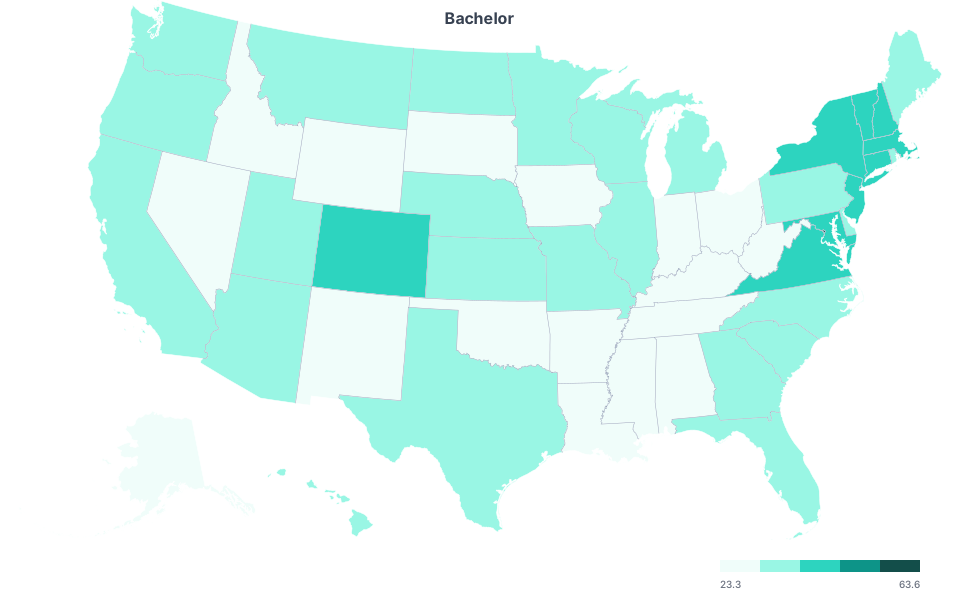
Full Ranking: Most Educated States
Source: Census ACS 5-Year Estimates
| # | State | Bachelor's+ | High School+ | Median Income |
|---|---|---|---|---|
| 1 | Wyoming | 29.9% | 94.1% | $74,815 |
| 2 | Wisconsin | 32.8% | 93.4% | $75,670 |
| 3 | West Virginia | 23.3% | 88.6% | $57,917 |
| 4 | Washington | 38.8% | 92.2% | $94,952 |
| 5 | Virginia | 41.5% | 91.3% | $90,974 |
| 6 | Vermont | 42.6% | 94.5% | $78,024 |
| 7 | Utah | 36.9% | 93.3% | $91,750 |
| 8 | Texas | 33.1% | 85.7% | $76,292 |
| 9 | Tennessee | 30.4% | 89.6% | $67,097 |
| 10 | South Dakota | 31.1% | 93.0% | $72,421 |
| 11 | South Carolina | 31.5% | 89.6% | $66,818 |
| 12 | Rhode Island | 37.3% | 89.5% | $86,372 |
| 13 | Puerto Rico | 29.1% | 80.4% | $25,096 |
| 14 | Pennsylvania | 34.5% | 91.9% | $76,081 |
| 15 | Oregon | 36.2% | 91.7% | $80,426 |
| 16 | Oklahoma | 27.8% | 89.1% | $63,603 |
| 17 | Ohio | 30.9% | 91.6% | $69,680 |
| 18 | North Dakota | 32.3% | 93.8% | $75,949 |
| 19 | North Carolina | 34.7% | 89.7% | $69,904 |
| 20 | New York | 39.6% | 87.9% | $84,578 |
| 21 | New Mexico | 30.2% | 87.7% | $62,125 |
| 22 | New Jersey | 42.9% | 90.7% | $101,050 |
| 23 | New Hampshire | 39.8% | 94.1% | $95,628 |
| 24 | Nevada | 27.4% | 87.4% | $75,561 |
| 25 | Nebraska | 34.1% | 92.1% | $74,985 |
| 26 | Montana | 34.5% | 94.6% | $69,922 |
| 27 | Missouri | 31.9% | 91.6% | $68,920 |
| 28 | Mississippi | 24.2% | 86.6% | $54,915 |
| 29 | Minnesota | 38.8% | 93.9% | $87,556 |
| 30 | Michigan | 31.8% | 91.9% | $71,149 |
| 31 | Massachusetts | 46.6% | 91.4% | $101,341 |
| 32 | Maryland | 42.7% | 91.0% | $101,652 |
| 33 | Maine | 35.3% | 94.5% | $71,773 |
| 34 | Louisiana | 26.6% | 86.9% | $60,023 |
| 35 | Kentucky | 27.0% | 88.5% | $62,417 |
| 36 | Kansas | 35.2% | 91.9% | $72,639 |
| 37 | Iowa | 30.9% | 93.2% | $73,147 |
| 38 | Indiana | 28.8% | 90.2% | $70,051 |
| 39 | Illinois | 37.2% | 90.3% | $81,702 |
| 40 | Idaho | 31.2% | 91.7% | $74,636 |
| 41 | Hawaii | 35.5% | 92.9% | $98,317 |
| 42 | Georgia | 34.2% | 89.0% | $74,664 |
| 43 | Florida | 33.2% | 89.6% | $71,711 |
| 44 | District of Columbia | 63.6% | 92.8% | $106,287 |
| 45 | Delaware | 35.3% | 91.4% | $82,855 |
| 46 | Connecticut | 41.9% | 91.3% | $93,760 |
| 47 | Colorado | 44.7% | 92.8% | $92,470 |
| 48 | California | 36.5% | 84.6% | $96,334 |
| 49 | Arkansas | 25.1% | 88.6% | $58,773 |
| 50 | Arizona | 32.6% | 89.1% | $76,872 |
| 51 | Alaska | 31.2% | 93.5% | $89,336 |
| 52 | Alabama | 27.8% | 88.1% | $62,027 |
Methodology
Rankings are based on American Community Survey (ACS) 5-Year estimates from the US Census Bureau. All 50 states and the District of Columbia are included. The ACS surveys approximately 3.5 million households annually and provides detailed demographic, social, economic, and housing data. 5-Year estimates offer the most reliable data for state-level comparisons by averaging responses over a 60-month period. Percentages may not sum to 100% due to rounding.
More Education Rankings
Explore Other Rankings
Related Rankings & Top Entities
Frequently Asked Questions
District of Columbia has the highest bachelor's degree rate at 63.6%, according to latest Census ACS data. Massachusetts and Colorado round out the top three.
West Virginia has the lowest bachelor's degree rate at 23.3%. Mississippi is second-lowest at 24.2%.
The median across all 52 states is 33.2%. Note that the national median and the state-level median are calculated differently, the state median represents the midpoint when all states are ranked.
This data comes from the American Community Survey (ACS) 5-Year estimates published by the US Census Bureau. The ACS surveys approximately 3.5 million households annually and provides the most comprehensive demographic data available between decennial censuses.
Rankings are based on the latest available Census ACS 5-Year estimates. The Census Bureau releases new ACS data annually. Our data was last updated on April 12, 2026.
Rankings are based on American Community Survey (ACS) 5-Year estimates from the US Census Bureau. All 50 states and the District of Columbia are included. The ACS surveys approximately 3.5 million households annually and provides detailed demographic, social, economic, and housing data. 5-Year estimates offer the most reliable data for state-level comparisons by averaging responses over a 60-month period. Percentages may not sum to 100% due to rounding.
Source: U.S. Census Bureau ACS, 2026.